Launching a crypto token sounds simple on the surface. A smart contract gets deployed, a supply is defined, and trading begins. In reality, that version rarely holds up. The projects that survive and grow tend to follow a structured path where product logic, token design, compliance, and distribution are planned together before anything goes live.
The process has also changed in the last two years. Users now expect clarity, exchanges expect stronger fundamentals, and regulators expect projects to show intent and structure from the start. This has made token launches more demanding, but also more predictable for teams that approach them properly. This guide breaks down what founders need to understand about the crypto token launch process, including cost, timeline, and core requirements.
Understanding What a Token Launch Actually Involves
A token launch is not just a technical milestone. It is a coordinated release of a digital asset into a live market where pricing, liquidity, user behavior, and product usage all start interacting immediately.
At a minimum, a launch involves:
- Smart contract deployment
- Tokenomics design
- Liquidity setup
- Exchange readiness
- Community and marketing execution
But these elements only work when they connect to a clear business model. A token that does not have a defined role inside a product tends to rely entirely on speculation, and that usually fades after the initial attention cycle.
In more stable projects, tokens are tied to repeat activity. That might include transaction fees, staking incentives, access to features, governance participation, or settlement within a platform. The stronger this connection is, the more predictable the token’s behavior becomes after launch.
The Complete Crypto Token Launch Process
Phase 1: Define the Token’s Purpose and Structure
Before any code is written, the project needs clarity on what the token actually does. This step often determines whether the project will feel useful or unnecessary once it reaches users.
The token’s role should answer a few direct questions:
- What actions require the token inside the product?
- Why would users hold it instead of just using it once?
- How does demand increase as the product grows?
For example, a DeFi platform might use its token for staking rewards and governance, while a gaming ecosystem may use it for in-game purchases and progression. In both cases, the token connects to user behavior that repeats over time.
Tokenomics is defined at this stage. Supply, allocation, vesting schedules, and emission models are planned in a way that balances early funding needs with long-term stability. Poorly structured tokenomics often leads to heavy sell pressure early on, which can weaken the project’s credibility.
Phase 2: Choose the Right Blockchain Network
The choice of blockchain affects cost, scalability, developer flexibility, and user accessibility. This is not just a technical decision; it influences how easily users can interact with the token.
Common options include:
- Ethereum for strong ecosystem support and liquidity access
- BNB Chain for lower transaction costs and faster execution
- Solana for high throughput and consumer-facing applications
- Polygon for scaling Ethereum-compatible applications
Each network has trade-offs. A project focused on DeFi liquidity might prioritize Ethereum, while a gaming project might lean toward faster and cheaper networks. The key is to match the token’s expected usage with the network’s strengths.
Phase 3: Smart Contract Development and Testing
Once the structure is clear, development begins. This involves creating the token contract based on standards such as ERC-20, BEP-20, or SPL.
This stage includes:
- Writing the smart contract logic
- Integrating features like minting, burning, or staking
- Testing for edge cases and vulnerabilities
- Conducting security audits
Security plays a critical role here. Even a small flaw in the contract can lead to exploits, fund loss, or reputational damage. Many projects now treat audits as a mandatory step rather than an optional one.
Working with a token development company at this stage can reduce risk, especially for teams without deep blockchain engineering experience. Experienced developers tend to follow tested frameworks while still adapting to project-specific requirements.
Phase 4: Legal and Compliance Preparation
Regulatory expectations have become stricter across major markets. Projects can no longer rely on vague positioning or unclear messaging.
Key considerations include:
- Whether the token could be classified as a security
- KYC and AML processes for participants
- Geo-restrictions for certain regions
- Clear documentation of token utility
For example, projects targeting users in Europe need to align with MiCA guidelines, while those engaging US participants must consider evolving regulatory frameworks. Ignoring compliance can lead to restrictions, delistings, or legal challenges later.
Phase 5: Build Early Community and Awareness
A token launch rarely succeeds without an existing audience. Community building usually starts well before the token becomes available.
This phase focuses on:
- Telegram and Discord engagement
- Social media presence across platforms like X
- Content that explains the project clearly
- Early supporter incentives and whitelist campaigns
The goal is not just to attract attention, but to create a group of users who understand and follow the project. This group often drives the first wave of activity after launch.
Phase 6: Token Sale or Distribution Strategy
Projects need to decide how tokens will enter circulation. This can happen through:
- Private or seed rounds
- Public presales or ICOs
- Airdrops or reward-based distribution
- Liquidity mining or staking programs
Each method affects price stability and community structure. A heavily discounted private sale can create early selling pressure, while a balanced distribution approach tends to support steadier growth.
Phase 7: Exchange Listing and Liquidity Setup
The final step before public trading involves listing the token on exchanges and providing initial liquidity.
This includes:
- Deploying liquidity pools on decentralized exchanges
- Negotiating listings with centralized exchanges
- Ensuring sufficient liquidity to support trading
Without proper liquidity, even a strong project can face extreme price volatility. This phase is often where technical execution meets market reality.
Crypto Token Launch Timeline: What to Expect
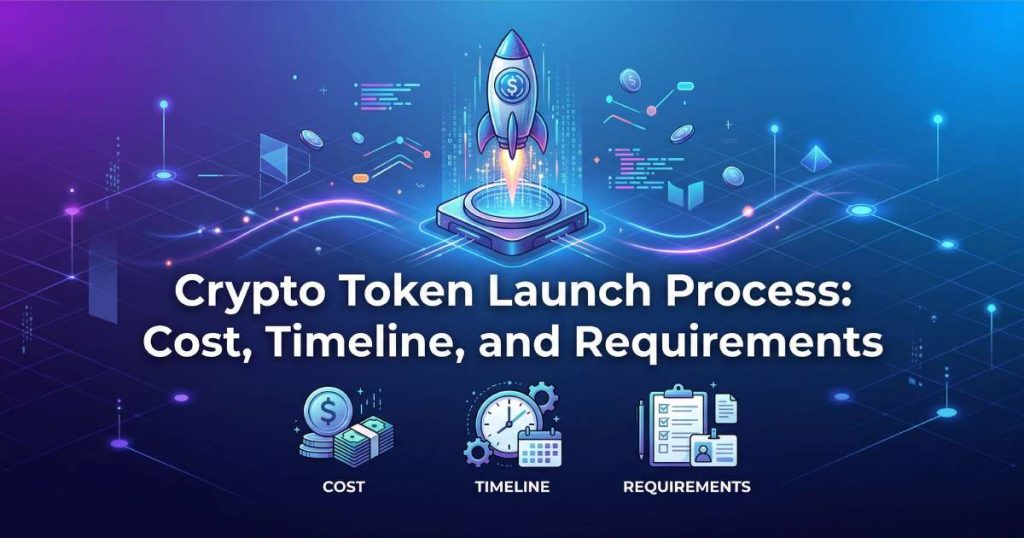
A realistic token launch timeline typically ranges from 8 to 16 weeks, depending on the project’s complexity and preparedness.
Early Planning (Weeks 1–3)
During this stage, the focus remains on defining the business model, token utility, and high-level structure. Teams also begin selecting blockchain networks and outlining tokenomics.
This phase tends to move quickly for experienced teams but can take longer for new founders who are still refining their concept.
Development and Testing (Weeks 4–8)
Smart contract development, internal testing, and security audits take place here. Parallel to this, early community building and marketing preparation often begin.
This stage requires careful attention. Rushing development increases risk, especially when dealing with financial systems.
Pre-Launch Preparation (Weeks 9–12)
Marketing efforts intensify, partnerships are announced, and token sale mechanics are finalized. Whitelists, early access campaigns, and community incentives are usually active at this point.
Exchange discussions may also begin during this phase.
Launch and Post-Launch Setup (Weeks 13–16)
The token is deployed, liquidity is added, and trading begins. After launch, the focus shifts toward maintaining activity, supporting users, and expanding the ecosystem.
Projects that plan for post-launch engagement tend to perform better than those that treat launch day as the finish line.
Crypto Token Launch Cost Breakdown
The cost of launching a crypto token varies widely based on complexity, scale, and strategy. A simple token can be launched for a few thousand dollars, while a full-scale project can require a six-figure budget.
Development Costs
Smart contract development and testing typically range from $3,000 to $15,000 for standard tokens. More advanced features like staking, governance, or cross-chain compatibility can increase this significantly.
Security audits add another layer of cost, often ranging from $5,000 to $25,000 depending on the depth of the review.
Marketing and Community Costs
Marketing often represents the largest portion of the budget. Campaigns can range from $5,000 for basic promotion to over $100,000 for full-scale global launches.
This includes:
- PR and media coverage
- Influencer partnerships
- Paid advertising
- Community management
Projects that invest in structured marketing tend to see stronger early traction.
Legal and Compliance Costs
Legal support varies based on jurisdiction and complexity. Basic advisory services may start around $5,000, while comprehensive compliance setups can exceed $50,000.
Exchange Listing and Liquidity
Listing fees for centralized exchanges can range from $10,000 to several hundred thousand dollars, depending on the platform.
Liquidity requirements also need to be considered. Projects often allocate a portion of their treasury to support trading activity during early stages.
Core Requirements for a Successful Crypto Token Launch
A token can be deployed in minutes, but a successful launch depends on preparation that happens weeks or months before that moment. The projects that hold value over time usually meet a clear set of requirements across product, technical, legal, and market layers.
A Clear Product Behind the Token
Tokens that exist without a working or near-ready product tend to struggle after launch. Users today look for signals of actual usage, not just future promises.
A strong setup usually includes:
- A working prototype, MVP, or testnet
- Defined user flows that involve the token
- Evidence that users will interact with the product repeatedly
For example, a lending platform where users deposit, borrow, and earn interest creates natural token demand through activity. In contrast, a token with no functional environment often depends entirely on trading volume, which is harder to sustain.
Balanced Tokenomics That Match Market Behavior
Tokenomics is often treated as a theoretical model, but in practice, it interacts directly with user psychology and market timing.
Well-structured tokenomics usually:
- Avoid large early unlocks that trigger sell pressure
- Align incentives between early backers and long-term users
- Reserve sufficient supply for ecosystem growth
A common mistake is allocating too much supply to early investors with short vesting periods. Once tokens unlock, selling pressure increases quickly, often affecting price stability and community sentiment.
Strong Technical Foundation and Security
Security is one of the few areas where mistakes cannot be reversed easily. A single exploit can impact funds, trust, and exchange relationships.
Projects should ensure:
- Smart contracts are audited by reputable firms
- Code is tested under different scenarios
- Access controls and admin permissions are carefully managed
Even experienced teams rely on external audits because independent reviews often catch issues that internal testing misses.
Compliance Awareness from the Start
Regulatory clarity has become part of the launch process. Even projects that operate globally need to consider jurisdiction-specific rules.
Basic compliance preparation includes:
- Defining whether the token has utility or investment characteristics
- Implementing KYC where required
- Avoiding misleading claims in marketing materials
Projects that ignore compliance often face challenges when trying to list on major exchanges or expand into regulated markets.
Liquidity and Market Readiness
Liquidity determines how smoothly a token trades after launch. Without it, even moderate buy or sell orders can cause sharp price swings.
A stable setup usually includes:
- Sufficient initial liquidity in DEX pools
- Market-making strategies for centralized exchanges
- Treasury allocation to support trading activity
Liquidity planning is often underestimated, but it plays a direct role in early market perception.
Real-World Example: How Token Launches Play Out
To understand how these elements connect, it helps to look at a simplified example.
Imagine a Web3 gaming platform preparing to launch its token. The team builds a playable demo where users earn rewards, upgrade characters, and access premium features using the token. During development, they design tokenomics that rewards active players while limiting early investor unlocks.
Community building begins early, with players testing the game and sharing feedback. By the time the token launches, there is already an active user base that understands how the token fits into gameplay.
Liquidity is added carefully, and the token is listed on a decentralized exchange first, followed by a centralized exchange once trading stabilizes. Because the token connects to ongoing activity, users continue engaging beyond the launch window.
This type of setup does not eliminate volatility, but it creates a foundation where usage supports value instead of relying entirely on speculation.
Common Mistakes That Delay or Damage Token Launches
Even well-funded projects encounter issues when certain steps are rushed or overlooked. Some patterns appear repeatedly across failed or underperforming launches.
Launching Without Product Readiness
When users cannot interact with the token beyond trading, interest tends to drop after the initial hype phase. This often leads to declining activity and weaker community engagement.
Overcomplicated Tokenomics
Adding too many mechanisms such as burns, reflections, and multiple reward layers can make the token difficult to understand. Simpler models often perform better because users can quickly grasp how value flows through the system.
Ignoring Post-Launch Strategy
Some teams focus heavily on launch day and underestimate what happens afterward. Without continued updates, partnerships, and engagement, momentum fades quickly.
Weak Community Foundations
Buying followers or running short-term campaigns without building real engagement often results in inactive communities. Active users tend to matter more than large but passive audiences.
Underestimating Costs
Projects sometimes allocate most of their budget to development while leaving limited resources for marketing, compliance, or liquidity. This imbalance can affect the entire launch outcome.
How to Improve Your Chances of a Successful Launch
A successful token launch is rarely the result of a single factor. It usually comes from aligning multiple elements that reinforce each other over time.
Projects that perform well often:
- Treat the token as part of a larger product, not a standalone asset
- Plan distribution carefully to manage early market behavior
- Invest in community building before and after launch
- Maintain transparency through updates and communication
- Adjust strategy based on user feedback and market response
Working with an experienced token development company can help structure this process more effectively. Teams that have handled multiple launches tend to anticipate challenges earlier and build systems that reduce risk.
Final Thoughts
The crypto token launch process has become more structured, not because the technology has changed, but because user expectations have matured. Investors, traders, and everyday users now look for clarity, usability, and consistency before they commit attention or capital.
Cost, timeline, and technical execution still matter, but they only tell part of the story. What happens before launch shapes initial traction, and what happens after launch determines whether that traction continues.
Projects that approach token launches as long-term ecosystem rollouts rather than one-time events tend to hold stronger positions in the market. The difference often comes down to preparation, alignment, and the ability to connect the token to real activity that keeps users coming back.